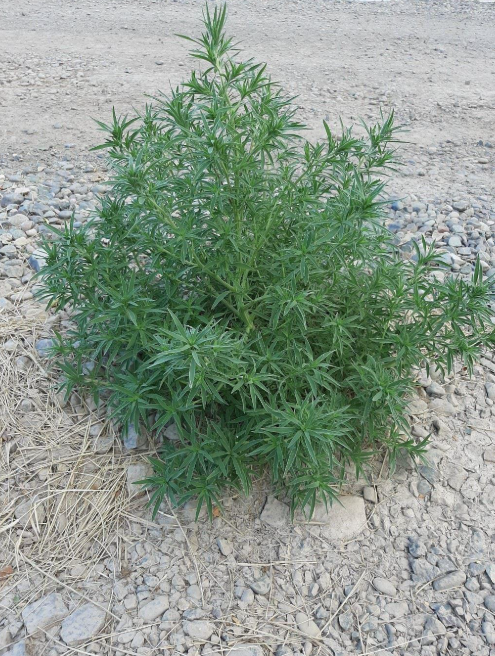
Mother Nature gave the summer annual broadleaf weed natural advantages — and it is exactly why Tex-Air Drone’s drone spraying services were built for mid-summer battles like this one. Texas A&M AgriLife Research has documented kochia’s spread into Texas High Plains cotton and grain sorghum fields. Often it is the first to sprout each spring. Its upright, branching growth can rise above cotton and grain sorghum canopies by mid-July. Those roots run deep into the soil and block sunlight. Next year’s crop yields could be affected by up to 100,000 seeds.
These seeds may spread along fields and fence lines. Worse, it’s increasingly herbicide resistant — kochia should be given no ground, for this season or next.
For producers in Texas and Oklahoma, invasive weeds like kochia are a problem. It is most visible in mid-summer. This is when plants begin to stand above the crop canopy. These late-season escapes can hurt crop health. They compete for moisture and nutrients. They can also cause weed problems next season. This is exactly where Tex-Air Drone’s drone spraying services provide a critical advantage over traditional application methods.
By mid-July, crop health is hurt by plants that rise above cotton or sorghum canopies. This shows the limits of crop dusting, spraying, and rig spraying in pre- and post-emergent windows. Agronomists call these natural factors “the timing problem.” It gets worse with the “ground rig problem.”
High-clearance sprayers can clear mature sorghum or cotton. But each pass can compact the root zone. This is worse when the soil is wet. Boom contact with a dense canopy can damage crops. This can add to yield loss already caused by kochia. It creates a classic case where the cure is worse than the disease.
Eliminating that tradeoff is where Tex-Air Drone’s next-level drone technology steps in. A trained drone operator can fly a treatment pass and precisely target areas with heavy kochia pressure. The operator can adjust application rates and swath patterns to apply product only where escape pressure is highest. That precision spraying lets the applicator apply more accurately, instead of treating every acre at the same rate.
With RTK-triangulated flight lines, a spraying drone flies low, just above the canopy. Its blades push the right amount of chemicals downward, reaching kochia that ground equipment cannot access cleanly, avoiding compaction and boom contact.
This is where modern agricultural spraying and precision agriculture begin working together. A mapped field can find problem areas first. Then an ag drone can apply herbicide or pesticide only where treatment is needed.
Quick Strikes — Closing The Treatment Window Before Seeds Set
The critical deadline with any escaped weed is seed set.
A ground crew treating a large kochia infestation across several fields may see early-treated plants recover. The latest-found plants may have already started to set seed. Aerial drone spraying services greatly reduce the timeline.
A drone can cover in one day what a ground crew would need several days to cover. Guided by site-defined multispectral imagery loaded into the drone’s mission, the goal is simple. Cover acreage fast enough to treat a whole field or farm. Do this within the short window between detecting weed escapes and seed set.
Targeting kochia-dense zones and applying crop protection products at the right rate gives producers a better tool, reducing or skipping areas where kochia pressure is light.
A flat-rate, full-field broadcast application cannot match this. Especially for interior weeds that will become a “next year problem,” we map the field. We find those spots and send the drone to spray only the areas confirmed by aerial maps.
That mix of mapping, prescription data, and precision spraying makes drone application more than another form of crop dusting. It becomes a targeted precision agriculture tool designed around the actual conditions in the field.
Tex-Air Drone’s agricultural drone spraying services offer targeted spraying for invasive weeds in Texas and Oklahoma. This includes kochia, where weed pressure is highest.
Who Should Be Calling for Drone Spraying Services Right Now?
If you are a row-crop producer in the Texas High Plains, South Plains, Rolling Plains, or western Oklahoma, watch for kochia. If you see it above your crop canopy or along field edges, the mid-summer treatment window is open now. It will not stay open for long.
If you have been searching for an agricultural drone service near me or agriculture drone spraying services near me, Tex-Air Drone provides another option when resistant kochia, wet soil conditions, or crop height make traditional spraying difficult.
Check Tex-Air Drone’s Texas, Oklahoma, and New Mexico service area, with dedicated offices in West Texas, East Texas, and North Texas. Contact Tex-Air Drone at 806-318-1825 or get a kochia drone spraying services quote from Tex-Air Drone to get your acreage on the schedule before the treatment window closes.
Frequently Asked Questions
Should I consider drones for all my spraying needs? Drone spraying services do not replace a well-designed pre-emergent program — they catch what the pre-emergent program will miss. This matters most in years with high resistant kochia pressure. In this context, drones can best be thought of as a guided missile coming in behind the “carpet bombing” of traditional crop dusting and rig-spraying.
What is the difference between a crop duster and an agricultural spraying drone? A traditional crop duster can provide rapid aerial application across large acreages. An agricultural spraying drone operates at a much lower altitude and can be directed using GPS-defined boundaries and prescription zones. The two technologies are different tools for different agricultural operations, field sizes, treatment objectives, and application conditions.
Can drone spraying target only the parts of a field with kochia? Yes. When kochia infestations are identified and mapped, treatment zones can be created so the spray drone focuses on confirmed problem areas rather than treating the entire field uniformly, thus reducing the environmental impact. That is one of the major advantages of combining drones and agriculture with precision agriculture. Mapping identifies the problem. Prescription data defines the treatment. The spraying drone executes the mission.
Does Tex-Air Drone sell DJI T100 Agriculture Drones? Yes, we do. In addition to providing commercial drone spraying services, Tex-Air Drone proudly offers the DJI T100 Agriculture Drone for sale. We don’t just fly them — we supply them. If you are looking to bring precision agriculture and invasive weed management in-house, purchasing your own drone is a great next step. When you buy from us, you are buying from experienced operators who understand the specific challenges of farming in Texas, Oklahoma, and New Mexico.
Expert Guidance: Because we use agricultural drones daily for kochia control, crop spraying, and pesticide application, we know exactly what it takes to operate them effectively in the field.
Ready to Upgrade? Contact us at 806-318-1825 to discuss pricing, availability, and how adding a DJI T100 to your equipment lineup can help you target problem areas and improve crop health.
Tex-Air Drone offers commercial drone spraying services — including kochia control, invasive weed management, precision herbicide application, crop spraying, and pesticide application — across Texas, Oklahoma, and New Mexico.