

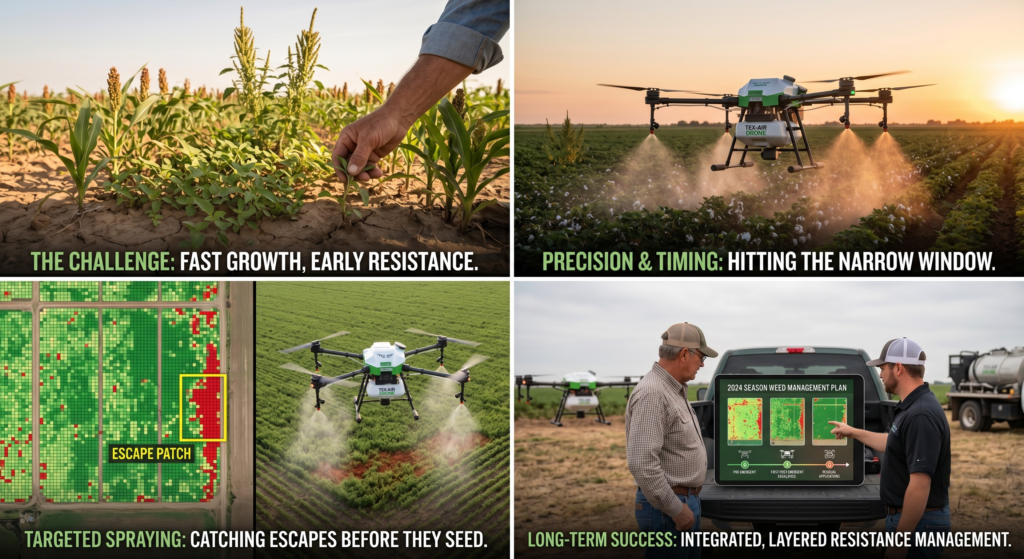
Every row-crop farmer in the Southern Plains has walked a field in late summer and found it: a patch of pigweed standing taller than the cotton or sorghum around it, having shrugged off a glyphosate pass that should have taken it down weeks earlier. That single uncontrolled plant is not a minor inconvenience. A mature Palmer amaranth plant can produce hundreds of thousands of seeds in a single season, and if even one resistant plant is allowed to go to seed, it can seed an entire field with resistant genetics for years to come.
This is why Palmer amaranth control has become one of the most consequential management decisions a Southern Plains row-crop operation makes each season. Palmer amaranth, the pigweed species responsible for some of the most aggressive herbicide resistance development in U.S. agriculture, has moved from an occasional nuisance to the single most economically damaging weed across cotton, corn, sorghum, and soybean acreage in Texas, Oklahoma, and New Mexico. Effective Palmer amaranth control today requires more than a single herbicide pass — it requires precision timing, layered chemistry, and the ability to catch the escapes that broadcast applications inevitably leave behind.
Tex-Air Drone provides aerial Palmer amaranth control services as part of its precision agriculture program, supporting row-crop operations across a service territory spanning roughly half of Texas, half of New Mexico, and a third of Oklahoma — the heart of the region where this resistance crisis is most advanced.
Why Palmer Amaranth Has Become the Toughest Weed in the Southern Plains
Palmer amaranth earned its reputation the hard way. It is dioecious, meaning male and female plants are separate, which drives the kind of genetic diversity that accelerates the spread of resistance traits through a population. It grows fast enough to outcompete row crops for light and water within weeks of emergence, and a single female plant’s seed production is measured in the hundreds of thousands.
Glyphosate resistance is the issue most producers are familiar with, and the Southern High Plains has become one of the regions where it is most established. A statewide survey of Palmer amaranth populations across Texas row-crop production regions, published in the journal Weed Technology, found that more than 60 percent of the populations sampled from the High Plains tested resistant to glyphosate at labeled field rates — a far higher resistance rate than was found in Central Texas, the Rio Grande Valley, or the Lower Gulf Coast. That regional concentration is exactly why Palmer amaranth control across the Southern Plains looks different today than it did a decade ago, when a single glyphosate application was often enough to clean up a field.
What Makes Palmer Amaranth Control So Difficult
Resistance is only part of the challenge. Palmer amaranth control is also complicated by the weed’s growth rate and its tendency to escape uniform treatment. Under good growing conditions, Palmer amaranth can grow several inches in a single day, which means the treatment window for many effective herbicide products — particularly contact and Liberty-type products that require small weeds for reliable control — closes faster than it does for slower-growing broadleaf weeds.
That narrow window creates a practical scheduling problem on any operation managing more than a few hundred acres. By the time a ground rig finishes spraying one section of a large farm, weeds in another section may have already grown past the size where the applied product still works. Palmer amaranth control programs that depend entirely on ground equipment are constantly racing a clock that resistant, fast-growing pigweed does not give much room to work with.
How Drone Spraying Strengthens Palmer Amaranth Control
Aerial application changes the math on that timing problem. Drone spraying covers acreage fast enough to treat an entire field — or several fields — while the pigweed population is still within the small-weed window that gives the applied herbicide its best chance of working. For Palmer amaranth control specifically, where treatment efficacy can fall sharply once weeds exceed four to five inches, that speed advantage is not a convenience. It is often the difference between a treatment that works and one that does not.
Drone deployment also supports the kind of targeted, supplemental Palmer amaranth control that a full-field ground pass cannot economically justify. When multispectral imaging or simple visual scouting identifies a patch of escaped pigweed in a portion of a field — something that happens on nearly every large operation regardless of how well the primary application was timed — a drone can be dispatched to treat that specific area without mobilizing ground equipment across the entire field for what amounts to a spot treatment.
Layering Modes of Action Into a Resistance Management Program
No single herbicide product is a complete Palmer amaranth control solution anymore, and producers across the Southern Plains have largely adapted to that reality by layering residual, pre-emergent products with targeted post-emergent applications rather than relying on one chemistry to do all the work. Drone application fits naturally into that layered approach because it offers the precision and timing flexibility to deliver a post-emergent pass exactly when the weed population — and the crop — are at the right stage, without waiting for ground equipment availability or field access conditions to align.
This layered strategy is now the standard recommendation from weed scientists working on resistance management across the region: rotate and combine modes of action, use residual herbicides to suppress the population before emergence, and treat post-emergent escapes while they are still small enough for the applied product to work. Drone-based Palmer amaranth control supports every stage of that program, but its clearest advantage shows up in that last stage — catching the post-emergent escapes before they have a chance to mature and add seed back into the soil bank.
Field Margins, Escapes, and Seed Bank Management
Some of the most persistent Palmer amaranth control failures happen not in the middle of a field but along its edges. Turn rows, fence lines, and field margins are notoriously difficult to treat uniformly with ground equipment, and they are exactly the kind of low-priority area that gets skipped when a ground crew is racing to finish a large acreage before weather changes. Pigweed that escapes along a field margin and goes to seed does not stay confined to that margin — wind, equipment, and water movement carry seed back into the productive part of the field in subsequent seasons.
Drone-based Palmer amaranth control is particularly well suited to these margin and escape scenarios because it does not face the same access constraints that make ground equipment reluctant to treat irregular edges and corners. A targeted aerial pass along problem margins, run as a supplement to the primary field-wide application, closes one of the most common gaps in a resistance management program — and it directly addresses the seed bank issue that turns a single season’s escape into a multi-year infestation.
Scheduling Palmer Amaranth Control Around the Southern Plains Growing Season
Timing a Palmer amaranth control program around the Southern Plains growing season means planning for more than one application window. Pre-emergent residual products go down ahead of or shortly after planting. The first post-emergent window typically follows within a few weeks, timed to catch the earliest emergence flush while weeds are still small. A second post-emergent pass, often targeting escapes and later-emerging plants, frequently follows several weeks after that — and this is where aerial application’s speed advantage matters most, since later-season weeds are growing in warmer conditions that accelerate the size-based treatment window even further.
Tex-Air Drone’s service territory — covering roughly half of Texas, half of New Mexico, and a third of Oklahoma through dedicated offices in West Texas, East Texas, and North Texas — is structured to support Palmer amaranth control on this multi-pass schedule, rather than treating aerial spraying as a single, isolated event disconnected from the rest of a season’s resistance management plan.
Getting Ahead of Resistant Pigweed Before It Sets Seed
The economics of Palmer amaranth control reward producers who treat the problem early and thoroughly rather than those who wait to see how bad an infestation gets before responding. A single resistant plant left to mature and set seed does not just cost yield in the current season — it deposits enough seed into the soil to complicate weed management on that acreage for years afterward.
Tex-Air Drone’s drone spraying services support row-crop operations across Texas, Oklahoma, and New Mexico with the speed and precision that effective Palmer amaranth control increasingly requires. To schedule a treatment, discuss a season-long resistance management plan, or get a targeted escape treated before it sets seed, contact Tex-Air Drone at 806-318-1825 or request a project quote. You can also view our full service area to confirm coverage for your location.
Frequently Asked Questions
Why has Palmer amaranth control become so much harder over the past decade? Widespread glyphosate resistance, confirmed across more than 60 percent of sampled High Plains populations in published research, means a single herbicide pass that once controlled pigweed reliably can no longer be counted on, which has pushed producers toward layered, multi-pass control programs.
Can drone spraying fully replace ground equipment for Palmer amaranth control? Drone spraying is most effective as part of a broader program — it excels at hitting tight timing windows and treating escapes or field margins, while pre-emergent residual applications and larger broadcast passes often still rely on ground or traditional aerial equipment depending on the operation.
How small do weeds need to be for effective Palmer amaranth control? Many of the most effective post-emergent products perform best on Palmer amaranth under four to five inches tall, which is part of why the speed of aerial application matters — a fast-growing pigweed population can outgrow that window in a matter of days.
Tex-Air Drone provides precision agriculture drone services — including Palmer amaranth control, drone spraying, multispectral weed detection, and variable rate herbicide application — to row-crop operations across Texas, Oklahoma, and New Mexico. The company operates dedicated offices in West Texas, East Texas, and North Texas.